
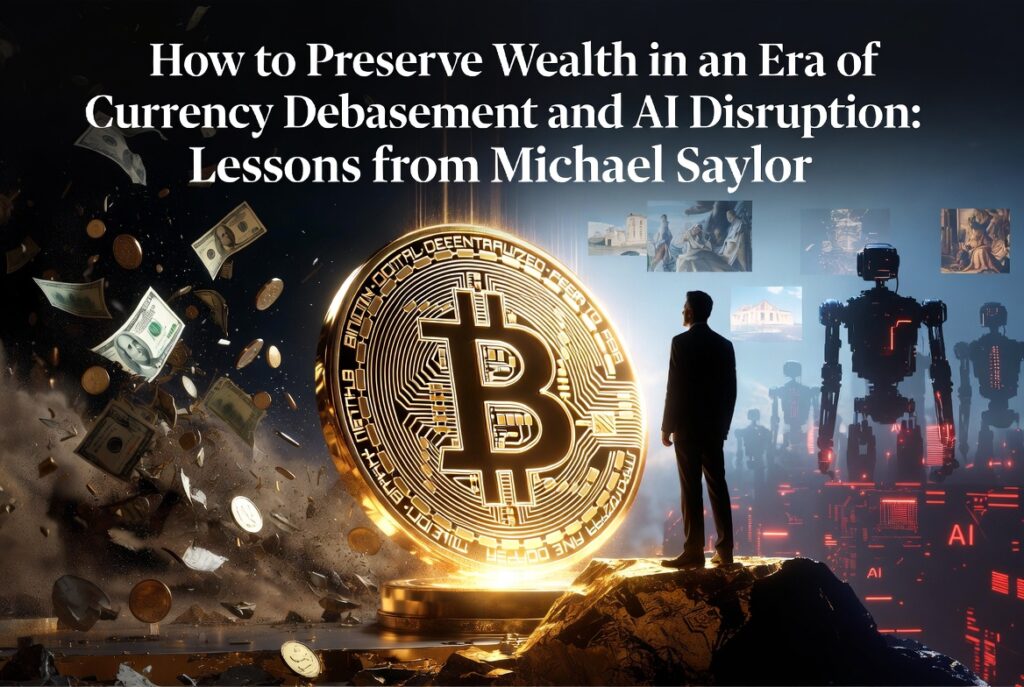
In a recent appearance on The Peter McCormack Show, Michael Saylor, Executive Chairman of Strategy (formerly MicroStrategy) and one of Bitcoin’s most vocal advocates, delivered a stark warning: traditional paths to wealth—hard work, saving in fiat currency, or relying on human labor—are eroding rapidly. With AI and automation poised to “demonetize” much of human capital over the next decade, preserving wealth requires a fundamental shift toward owning scarce, desirable assets. Saylor’s insights, grounded in economic history, monetary theory, and technological foresight, offer a timely blueprint for individuals and families seeking to protect and grow their prosperity.
The Silent Erosion: Why You Feel Poorer
Saylor explains that the core issue is ongoing currency debasement. The U.S. dollar supply has expanded at roughly 7% annually for a century, funding government deficits, wars, and social programs through inflation rather than direct taxation. This “stealth tax” quietly diminishes the purchasing power of cash savings, wages, and fixed-income assets. Those without scarce assets bear the brunt, as their money buys less over time while asset owners benefit from appreciation.
History shows this is not new. From ancient empires to colonial America, governments have debased currencies to meet ambitions, leading to cycles of inflation, stagnation, or crisis. Second-tier currencies (like the pound or euro) debase somewhat faster than the dollar, while lower-tier ones collapse more dramatically. The result? Economic malaise for many, even as innovation in free-market sectors (think AI, robotics, and digital assets) creates extraordinary new wealth for a few.
In this environment, simply working harder or saving in a bank account is insufficient. As Saylor notes, “If you want to create wealth or preserve wealth, it’s not enough to just work yourself to death.”
The AI Shift: Labor Loses, Ownership Wins
Saylor highlights a 10-year window before AI and robotics profoundly reshape the economy. Human labor—both blue- and white-collar—is becoming cheaper and less valuable as machines handle repetitive, scalable tasks. Value is migrating from effort and talent alone to ownership, leverage, and positioning in productive assets.
This demonetization of human capital means traditional income streams may stagnate or decline relative to asset prices. The winners will be those who own pieces of the future: scarce digital or physical property that retains or gains desirability amid abundance in other areas.
Saylor’s Core Strategy: Own Scarce, Desirable Assets (The “Bernard Arnault Test”)
Saylor’s practical advice for preservation is elegant and timeless: Buy assets that someone richer, more cultured, and more intelligent than you will want to buy from you in a decade. He calls this the “Bernard Arnault test,” referencing the LVMH luxury magnate’s focus on enduring, high-status holdings.
Historical precedents include:
- Renaissance Italian art as portable capital.
- Diamonds, gold, and livestock in earlier eras.
- Prime real estate, mineral rights, iconic intellectual property (e.g., The Beatles catalog), and cultural assets today.
These are scarce and desirable—not easily reproducible, portable (or digitally so), and sought after by future elites.
Bitcoin as the pinnacle: Saylor positions Bitcoin as superior “digital capital” and the hardest form of money ever created. With a fixed supply of 21 million coins, it is decentralized, censorship-resistant, and beyond any single government’s control. Unlike physical assets vulnerable to seizure or regulation, or fiat eroded by printing, Bitcoin offers thermodynamic security (via proof-of-work) and global portability. He advises against selling it for lesser assets: “Bitcoin is a stronger form of capital preservation than your house, a bar of gold, or a bunch of silver.”
For those wary of volatility, Saylor’s Strategy has pioneered instruments like Bitcoin-backed preferred stock for stable yields, enabling compounding with tax advantages for generational wealth.
Practical Steps to Preserve and Build Wealth
- Audit Your Holdings: Move away from cash and depreciating assets. Prioritize scarcity over yield in inflationary environments.
- Acquire Scarce Assets: Start with Bitcoin as a core digital holding. Supplement with prime real estate, quality equities in innovative sectors, or unique IP. Diversify thoughtfully but recognize Bitcoin’s unique properties.
- Leverage Productively: Use debt strategically (as Strategy does) to acquire more Bitcoin, but only if aligned with long-term conviction. Focus on assets that appreciate faster than the cost of capital.
- Think Intergenerationally: Don’t sell core holdings like Bitcoin for short-term needs. Position for your children’s children. Educate yourself on self-custody and sound money principles.
- Adapt to AI: Develop skills in ownership and capital allocation rather than pure labor. Use the next decade to build exposure before opportunities narrow.
Risks and Realities
No strategy is risk-free. Bitcoin’s price can be volatile (“volatility is vitality”), regulations evolve, and black swan events occur. Saylor emphasizes long-term conviction over timing. Traditional diversification still has a role, but in a debasing world, “no second best” in the hardest money category.
Broader wealth preservation also involves legal structures (trusts, entities), tax efficiency, insurance, and personal resilience—health, networks, and continuous learning.
Conclusion: The Choice Is Yours
Michael Saylor’s message is urgent yet empowering. In an age where governments expand, currencies dilute, and technology disrupts labor, wealth preservation demands ownership of the scarce and eternal. Bitcoin, as digital property, represents a breakthrough: a bearer instrument for the digital age that no politician can inflate or confiscate easily.
The window is open—but narrowing. Those who act by securing stakes in scarce assets today will thrive, while others watch their efforts and savings erode. As Saylor urges, stop trading time solely for depreciating money. Own the future.



0 Comments